
Views: 0 Author: Site Editor Publish Time: 2026-06-04 Origin: Site


Yard maintenance habits have changed drastically in recent years. Battery-powered tools swiftly replaced gas models for occasional users. However, aggressive marketing campaigns often exaggerate their true capabilities. You face a very specific challenge. Homeowners and property managers need a reliable tool for sudden storm damage and routine pruning. You also want to avoid the constant maintenance overhead of a traditional two-stroke engine.
Choosing the right specialized tool requires careful evaluation. Buying the wrong bar size, motor type, or battery configuration leads to serious problems. You might experience stalled motors, pinched bars, or severe safety risks. This guide provides an evidence-backed evaluation framework. We will help you match the exact tool to your real-world yard applications. You will learn how to parse specifications and prioritize critical safety features for any cleanup job.
Match Battery to Motor, Not Just Bar Size: Avoid small-capacity batteries (e.g., 4Ah on larger saws); they cause stalling out. Look for 5Ah+ to handle instantaneous torque demands.
Understand the "Instantaneous Torque" Risk: Electric motors deliver max torque immediately, meaning they can shred traditional gas-saw protective chaps. Safety gear must be rated accordingly.
Hardware Traps: Avoid dial-style chain tensioners that jam with sawdust; prioritize brushless motors for sustained pruning and storm cleanup.
Weather Limitations: Despite their convenience for storm cleanup, cordless chain saws are electrical devices—cutting in the rain or storing batteries above 120°F introduces severe hazards.
You must define the capability ceiling before purchasing any equipment. A cordless mini chainsaw typically features a bar length between 4.5 and 12 inches. Manufacturers engineer these tools specifically for limbing, pruning, and cutting branches up to 8 or 10 inches in diameter. They are absolutely not designed for felling 30-inch mature oak trees. Pushing a small battery tool beyond its intended diameter leads to rapid overheating and mechanical failure.
Many modern tool designers utilize a "small bar, high power" strategy. They pair high-power brushless motors with shorter guide bars. This smart configuration prevents the motor from bogging down under a heavy load. It provides a much smoother cut than an underpowered motor struggling to spin an oversized bar. You gain cutting efficiency by matching ample motor power to a concise cutting area. The saw stays at optimal RPMs rather than stalling out mid-cut.
Removing the combustion engine drastically reduces physical vibration. This change significantly impacts long-term user health. Gas engines produce intense vibrational frequencies. These frequencies cause severe hand fatigue and can lead to capillary damage over time. A battery-powered tool operates smoothly. It protects your hands during extended yard cleanup sessions. You can work longer without experiencing the numbness typically associated with heavy two-stroke engines.
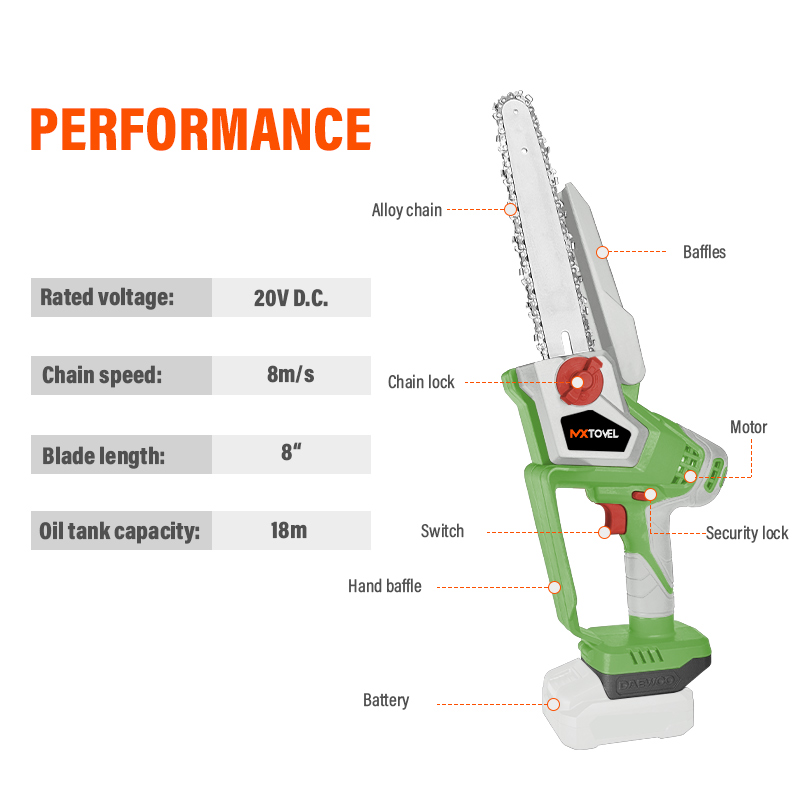
Working directly in the canopy requires specific tool dimensions. A handheld chainsaw offers an ideal form factor. Its lightweight nature often keeps the tool under five to seven pounds. This light footprint allows you to make controlled, precise cuts from awkward angles. Trying to leverage a full-sized gas saw while reaching overhead is both dangerous and physically exhausting. A smaller tool gives you better balance and control.
Noise and emissions often dictate when you can perform yard work. Urban environments and Homeowner Associations (HOAs) enforce strict noise ordinances. Zero-emission, low-decibel operation solves this problem entirely. You can start early morning property maintenance or handle weekend tasks without bothering your neighbors. It eliminates the loud idling and toxic exhaust fumes associated with traditional landscaping equipment.
You should follow a simple shortlisting logic for routine maintenance. A 6-inch to 10-inch bar handles most light DIY duties perfectly. Standard battery packs usually provide enough runtime for basic seasonal pruning. However, you must carefully check the oiling mechanisms on these smaller units. Many micro-saws lack automatic oilers. They require manual oiling before every few cuts. Failing to lubricate the chain destroys the bar rapidly due to metal-on-metal friction.
Consider the following application targets when selecting a bar size:
4.5 to 6 inches: Ideal for rose bushes, small fruit tree pruning, and light shaping.
8 to 10 inches: Perfect for removing dead limbs, breaking down fallen branches, and general yard upkeep.
12 inches: Suitable for heavier firewood bucking and processing thicker storm debris.
Storms leave behind messy, dangerous yards. However, you must acknowledge the "after the rain" reality. People frequently buy a portable chainsaw specifically for storm cleanup. We must warn you explicitly against operating these tools in active rain or standing water. They are electrical devices. Moisture introduces severe electrical shorting risks. All storm cleanup tasks must happen strictly after the weather clears and conditions dry.
You need to set realistic expectations for your battery life. Workloads vary based on wood density and moisture content. A quality 18V or 20V system paired with a 5Ah battery delivers impressive results. It typically yields enough cuts to fill an entire short-bed pickup truck with 14-inch to 18-inch firewood logs. Dropping down to a 2Ah battery drastically reduces this output. You will likely spend more time waiting for chargers than actually cutting wood.
Storm debris rarely sits perfectly flat. Branches remain under unpredictable tension. Novice users frequently get their saw pinched and permanently stuck in binding wood. The wood pinches the guide bar tightly as the branch shifts. You should always budget for a backup bar and chain. This allows you to detach the motor head and mount fresh hardware.
Follow these steps if your saw becomes pinched:
Turn off the tool immediately to prevent motor burnout.
Remove the battery pack to ensure absolute safety.
Assess the tension. Determine if lifting or supporting the branch will open the cut.
If hopelessly stuck, detach the powerhead from the trapped bar.
Install your backup guide bar and chain.
Make a new relief cut several inches away to free the trapped hardware.
Motor architecture determines long-term viability. Brushless motors represent a non-negotiable requirement for anything beyond infrequent pruning. Brushless technology removes the physical carbon brushes. This design drastically reduces internal friction. It improves thermal efficiency and extends runtime significantly. A cordless chain saw equipped with a brushless motor runs cooler and delivers consistent power under heavy loads.
Chain tensioning mechanisms require careful inspection. Many consumer-grade tools feature dial-style chain tensioners. Manufacturers advertise these as "tool-less" convenience features. We strongly advise against them. Dial-style tensioners frequently fail, freeze, or pack tightly with wet sawdust during rigorous conditions. You should opt for traditional scrench-adjusted tensioners instead. Bolted tensioners use simple, reliable physics. They will not slip when you tackle heavy, wet storm debris.
Battery architecture matters just as much as motor type. Battery Ah (Amp-hour) ratings dictate overall performance, not just runtime. High-draw applications require massive amounts of instant current. Cutting through dense, wet storm debris pulls significant energy. Lower-tier batteries cannot deliver this current fast enough. They will trigger thermal shutdown circuits to protect the cells. You will experience frustrating stalls mid-cut.
Component | Consumer-Grade Spec | Professional-Grade Spec | Operational Impact |
|---|---|---|---|
Motor Type | Brushed | Brushless | Brushless prevents overheating during continuous cutting sessions. |
Battery Capacity | 2Ah or 4Ah | 5Ah to 8Ah | Higher Ah sustains instant torque and prevents thermal shutdown. |
Tensioning System | Tool-less Dial | Scrench/Bolted | Bolted systems resist jamming from wet sawdust and debris. |
Oiling System | Manual Primer Bulb | Automatic Oiler | Auto-oilers ensure constant lubrication, saving guide bar lifespan. |
People often falsely assume battery-powered tools are inherently safe. This misconception leads to serious injuries. A mini electric chainsaw delivers maximum torque instantly upon trigger pull. Gas saws need time to rev up and engage a clutch. Electric motors bypass this entirely. The instantaneous torque hazard requires total concentration from the moment your finger touches the trigger.
Personal Protective Equipment (PPE) compatibility presents a unique challenge. Traditional safety chaps utilize Kevlar fibers designed to jam the spinning sprocket of a gas saw. This stalls the combustion engine. However, electric motors deliver continuous, relentless torque. They can easily tear completely through standard gas-rated chaps. You must ensure your protective gear carries a specific rating for electric motors. Standard gear will fail to protect you.
Kickback forces remain a severe threat regardless of your power source. Physical kickback occurs when the upper tip of the guide bar catches the wood. It violently throws the tool back toward your face. The power source does not change this physical reality. You must maintain a firm grip and avoid cutting with the upper quadrant of the bar tip.
Battery storage requires strict fire compliance. Lithium-ion batteries pack incredible energy density. You must keep them stored safely away from extreme temperatures. Storing these batteries above 120°F introduces severe fire risks. Never leave them baking in a hot vehicle or resting in direct sunlight during summer yard work.
Purchasing the right equipment comes down to specific operational logic. You should size the guide bar for your average branch diameter to maximize RPM stability. Always over-spec your battery capacity to ensure high torque stability and prevent thermal shutdowns. Furthermore, insist on a brushless motor for any serious storm cleanup or continuous pruning tasks.
Your immediate next step is to audit your current tool ecosystem. Check your garage to see if you already own 18V or 20V batteries from a reliable brand. If you do, you can significantly lower your barrier to entry. Purchase a "bare tool" that fits your existing batteries. Prioritize safety gear specifically rated for electric equipment before making your first cut.
A: Yes, if equipped with a brushless motor and a high-capacity battery, though the feed rate must be slower than with a gas saw. You must let the motor dictate the cutting speed rather than forcing the bar down into the dense wood grain.
A: Often caused by using a low-capacity battery (e.g., 2Ah or 4Ah) that cannot supply the required instantaneous current, triggering the tool's protective shutoff. Upgrading to a 5Ah or higher battery usually resolves this thermal shutdown issue entirely.
A: Generally, no. Dial-style tensioners are prone to jamming with debris; traditional bolted tensioners offer better reliability in heavy use. Wet sawdust frequently packs into the plastic dials, rendering them impossible to turn without breaking.
A: Yes. Friction destroys chains rapidly. Some micro models require manual oiling, while 10-inch+ models usually feature auto-oilers. Operating any chain without proper lubrication will overheat the bar and dull the cutting teeth almost immediately.


