
Views: 0 Author: Site Editor Publish Time: 2026-06-06 Origin: Site


High-volume drywall installation demands tools balancing speed, consistency, and operator endurance. Standard drills fail miserably at scale due to poor depth control and rapid motor burnout. Upgrading to a specialized brushless drywall screwdriver serves as a direct investment in labor efficiency and material quality. You prevent torn face paper and popped screws. This ultimately saves hours of tedious rework. Drywall hanging requires precision under pressure. Bringing the wrong tool leads to massive job site delays.
This guide breaks down the critical technical specifications required to evaluate these modern tools. You will learn how to shortlist the right equipment for commercial construction or extensive residential renovations. We cover everything from RPM requirements to ergonomic profiles to ensure you make the best choice for your crew.
Brushless motors offer up to 50% longer runtime per charge and eliminate carbon brush maintenance, crucial for high-dust environments.
Optimal RPM (4,000–5,000) prioritizes driving speed over raw torque, aligning with standard drywall fastening requirements.
Ergonomics and weight distribution (typically under 3.5 lbs with battery) directly impact daily production rates and contractor fatigue.
Selecting between collated (auto-feed) and single-screw configurations depends on crew size, budget, and specific project scope.
Traditional brushed motors suffer terribly from thermal overload. They experience rapid wear when exposed to fine gypsum dust during continuous operation. Drywall dust is highly abrasive. It infiltrates the motor housing and ruins standard carbon brushes quickly. This creates a significant business problem for large crews facing tight deadlines.
The modern solution relies on advanced electronic commutation. A brushless screwdriver completely eliminates physical brushes. Electronic commutation reduces internal friction and lowers operating temperatures significantly. This fundamental design shift extends the tool's lifecycle far beyond standard brushed equivalents.
You also gain massive energy efficiency. Brushless technology maximizes the power output drawn from the battery. Operators can hang considerably more sheets per single charge. This efficiency directly reduces the number of battery cycles needed throughout the workday. Your team spends less time waiting on chargers and more time fastening panels.
Professional crews often remain skeptical about higher upfront pricing. Initial procurement costs typically run 20 to 30 percent higher for brushless models. However, the drastic reduction in daily downtime easily justifies this premium. You get a reliable tool capable of surviving harsh commercial environments without constant servicing.
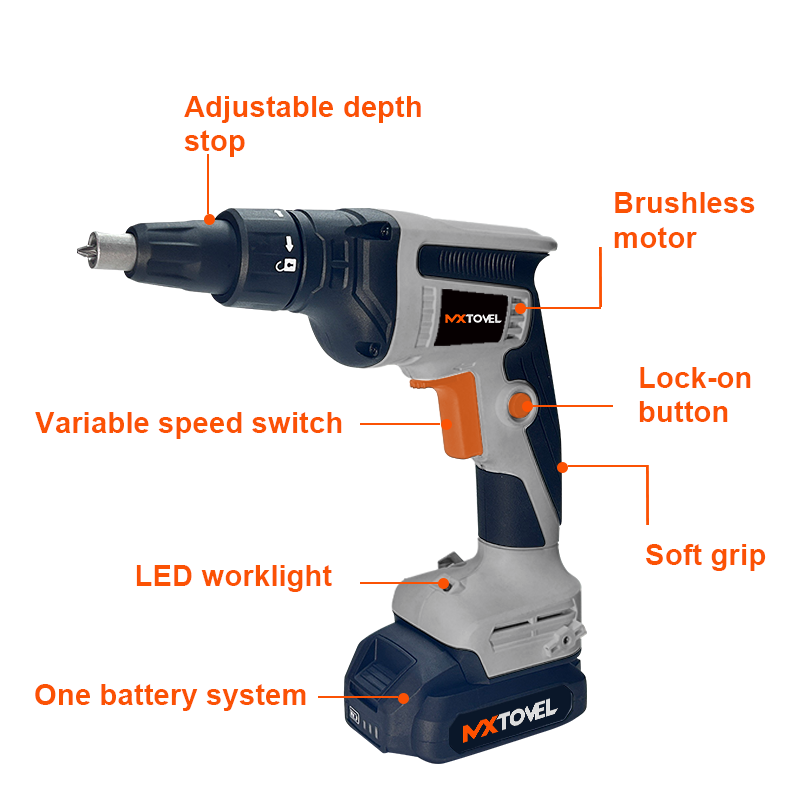
Drywall installation requires high speed instead of massive torque. Standard wood screws need heavy driving force. Conversely, drywall screws pierce soft gypsum and light-gauge steel quickly. You must evaluate the tool based on its rotational speed first. Look for a baseline of 4,000 to 5,000 RPM. This range handles standard drywall-to-wood or light-gauge steel framing perfectly. You should reserve high-torque, lower-RPM models strictly for heavy-gauge metal framing applications.
Power platforms often cause confusion on the job site. You will frequently see tools marketed as 18V or 20V Max. As an industry expertise callout, we must clarify these nominal ratings are functionally identical. A 20V screwdriver operates on the exact same actual voltage as an 18V unit under load. Your evaluation criterion should focus strictly on amp-hour capacity. We recommend utilizing 2.0Ah batteries for critical weight savings. You must also ensure the new tool matches your crew's existing battery ecosystem.
Trigger and lock-on mechanisms define your daily operational pace. A continuous lock-on switch is an absolute necessity. Combine this feature alongside a push-to-drive motor. In this setup, the motor only spins when you apply physical pressure to the screw head. This specific field reality remains non-negotiable for commercial speeds. It saves battery life and drastically reduces ambient noise on the site.
Tool Specifications Guide: Application Matching | |||
Primary Application Material | Recommended RPM | Torque Priority | Ideal Battery Ah |
|---|---|---|---|
Standard Drywall to Wood Studs | 4,000 - 5,000 RPM | Low (Speed Focus) | 2.0Ah (Lightweight) |
Standard Drywall to Light-Gauge Steel | 4,000 - 5,000 RPM | Low to Medium | 2.0Ah (Lightweight) |
Heavy-Gauge Metal Framing | 2,500 RPM | High (Torque Focus) | 4.0Ah or higher |
Subfloor Installation | 2,500 - 3,000 RPM | High | 4.0Ah or higher |
Your drywall screwdriver must deliver exact fastening depths on every single drive. The nosepiece and depth adjustment dictate this outcome completely. Proper depth prevents overdriving. Overdriving breaks the drywall face paper and ruins the screw's holding power. Proper depth also prevents under-driving. Under-driving leaves screw heads protruding. This creates massive finishing delays for your taping crew. Your evaluation criterion should focus on micro-adjustable, tool-free depth collars. These collars must hold their exact setting despite constant tool vibration.
Weight distribution and grip style directly impact user fatigue. Contractors often spend hours doing challenging ceiling installations and prolonged wall runs. An inline grip design is mandatory. This design allows operators to push force directly behind the drive bit. It prevents wrist strain and improves driving accuracy. An ideal operational weight falls exactly between 2.5 to 3.5 lbs, including the attached battery pack. Anything heavier will drain your crew's endurance by early afternoon.
Do not overlook built-in LED illumination. This feature greatly improves fastening accuracy in poorly lit commercial renovations. Residential basements also suffer from terrible temporary lighting. A bright, base-mounted LED eliminates shadows right at the fastening point. It helps the operator see pencil lines and stud marks clearly without relying on external work lights.
You must match the tool configuration directly to your current project scope. A single-screw standard configuration works best for custom renovations. It excels in tight spaces and handles standard residential drywalling perfectly. The primary advantage is a much lower upfront cost. The tool remains compact and highly maneuverable in corners. However, it relies entirely on the operator's manual feeding speed.
Collated, or auto-feed, attachments serve a very different purpose. They are best utilized for large-scale commercial construction, massive long wall runs, and subfloor installations. This system drastically increases your fastening speed. It also allows comfortable one-handed operation. The downsides are noticeable. Collated screws cost significantly more per box. Furthermore, the attachment itself adds bulk and noticeable weight to the front end of the tool.
Hybrid solutions provide excellent middle-ground flexibility. You can evaluate an electric screwdriver offering modular capabilities. These models allow for fast, tool-free switching between single and collated magazines. This approach suits contractors handling highly varied workloads. Your team can utilize collated strips for main walls and switch to single-screw mode for complex angles.
Configuration Comparison Chart | |||
Configuration Type | Best Suited For | Primary Advantage | Key Limitation |
|---|---|---|---|
Single-Screw | Custom renovations, tight spaces | Low cost, highly compact | Slower manual feed rate |
Collated (Auto-Feed) | Commercial sites, long wall runs | Extreme speed, one-handed use | Heavier, expensive consumables |
Hybrid (Modular) | Mixed residential and commercial | Maximum job site versatility | Slightly bulkier than dedicated tools |
High-volume fastening exposes tools to extreme conditions. Even premium brushless models require routine care to maintain peak performance. Ignoring basic maintenance leads to premature tool death and ruined materials. You must address these specific risks proactively.
Gypsum Dust Ingress: Drywall dust coats internal components constantly. Even brushless models are susceptible to switch failures if you ignore dust management. Regular blow-outs utilizing compressed air are absolutely required. We recommend clearing the trigger mechanism and ventilation ports weekly.
Cam-Out and Bit Wear: Standard Phillips #2 bits wear out rapidly during high-speed framing. Failure to replace bits regularly leads to cam-outs. This strips screws and damages the drywall face, regardless of overall tool quality. You should swap bits the moment they show rounded edges.
Cold Weather Battery Degradation: Lithium-ion batteries lose efficiency in freezing, unheated construction zones. Cold packs deliver less runtime and lower voltage. Mitigation requires active battery management. Keep spare batteries inside heated crew trucks or insulated cases until needed.
Selecting the best model requires matching technical capabilities to your daily reality. Use this simple logic sequence to finalize your purchase decision without overspending.
Step 1: Audit Current Inventory. Does the tool match your existing battery platform? Sticking to your current brand avoids redundant charger and battery purchases. This keeps your truck organized and highly efficient.
Step 2: Define the Primary Use Case.
Commercial Framers: You must prioritize 5,000+ RPM push-to-drive models featuring collated capabilities. Speed is your primary metric.
Renovation Specialists: You should prioritize lightweight, compact models offering highly precise depth control. Maneuverability trumps raw speed in complex residential layouts.
Step 3: Evaluate Warranties and Service. Assess the manufacturer's typical turnaround time for repairs. A fast service network keeps tools in the field. Prolonged downtime directly impacts your project margins.
Upgrading your framing equipment yields immediate production benefits. You must prioritize a model featuring a reliable push-to-drive mechanism. Ensure the depth adjustment collar is accurate and holds firmly under vibration. Select a weight class properly suited for your daily workload to prevent afternoon fatigue.
Avoid buying strictly based on peak power. Instead, focus on optimal RPM ranges matched to your specific materials. We highly recommend testing the ergonomics in-hand before committing. Attach your standard battery pack to the tool. Check the balance and inline grip feel. Taking these actionable steps guarantees you select a tool capable of driving thousands of fasteners cleanly.
A: While possible for minor patches using a dimpler bit, standard drills lack precise depth control. This leads to damaged panels. Impact drivers are entirely too aggressive. They will easily punch right through the delicate paper face, ruining the panel's holding power completely.
A: A dedicated drywall screwdriver features a specialized nose cone for strict depth-stop capability. It also utilizes a high-RPM motor and often includes a push-to-drive mechanism. A standard electric screwdriver focuses on lower speeds designed for general fastening tasks.
A: Yes, they are highly valuable for high-volume commercial jobs. The intense labor savings from increased driving speed outpaces the premium cost of collated screw strips easily. For small renovations, standard single-screw operation remains much more cost-effective.


