
Views: 0 Author: Site Editor Publish Time: 2026-06-07 Origin: Site


Traditional corded and pneumatic adhesive systems often create significant operational friction. Trailing cables introduce serious tripping hazards across the floor. Hoses limit mobility around large pallets. They tightly constrain your assembly cell layouts. Moving away from these tethered tools provides ultimate freedom on the shop floor. However, shifting to a cordless hot melt glue gun introduces brand new operational variables. You now must manage daily battery lifecycles. You must carefully monitor thermal recovery phases. Operators also need to ensure sustained extrusion rates under continuous pressure.
Finding the right cordless adhesive system takes far more than checking basic voltage metrics. You need to carefully evaluate continuous melt rates. You must confirm battery ecosystem compatibility. Operator ergonomics also play a massive role in daily productivity. This strategic approach ensures your new tools truly enhance production rather than slow it down.
Cordless mobility reduces OSHA-related tripping hazards and increases efficiency for large-scale carton sealing and multi-point assembly.
Industrial viability depends on continuous melt rate (lbs/hour) and thermal recovery, not just battery capacity.
Standardizing on a universal 20V glue gun platform streamlines procurement and battery management.
Precision tasks benefit from a mini lithium glue gun, while heavy packaging requires high-wattage, variable-temperature 20V units.
Cords and hoses act as invisible leashes on your production floor. They severely restrict operator movement during end-of-line packaging. Workers struggle to navigate around large pallets effectively. Pallet stabilization tasks become slow and cumbersome. Large-chassis manufacturing also suffers when operators cannot walk freely around the product. A completely wireless setup eliminates these workflow bottlenecks immediately. Operators move fluidly from station to station. They seal cartons and apply adhesives without constantly repositioning heavy power cords.
Safety compliance drives many facilities toward wireless tools. Eliminating trailing power cords drastically reduces trip-and-fall hazards. Removing compressed air hoses clears walkways instantly. These changes directly support strict OSHA compliance metrics. A safer floor means fewer workplace injuries and lower insurance premiums. Workers also experience less frustration. They focus entirely on the assembly task instead of managing tangled cables.
Evaluating the financial impact requires a strict cost-to-output analysis. Cordless units and industrial batteries carry a higher upfront cost. However, this initial investment easily offsets the reduction in cycle times. Highly mobile tasks proceed much faster. Operators complete multi-point assembly jobs in a fraction of the original time. The increased output volume justifies the initial hardware expenditure quickly.
We must acknowledge realistic limitations. Cordless systems excel at mobility and intermittent high-volume sealing. They perfectly handle customized packaging stations. Yet, fully automated stationary lines still favor bulk melt tanks. High-speed, continuous robotic extrusion requires massive adhesive volumes. You should deploy a cordless glue gun where human mobility provides the highest operational value.
Many procurement teams mistakenly focus solely on peak wattage. True industrial viability relies entirely on sustained melt rate and thermal recovery. Manufacturers measure this metric in pounds per hour (lbs/hr). A reliable hot melt glue gun must maintain target viscosity during continuous extrusion. Fast trigger pulls can strip heat from the heater block quickly. If the thermal recovery lags, the tool produces "cold spots." Cold adhesive ruins structural integrity and causes packaging failures. You need a heater block capable of rapid heat replenishment.
Precise temperature control dictates adhesive success. Digital displays and variable temperature settings prove absolutely necessary. Different hot melt formulations demand specific heat ranges. Standard EVA (Ethylene Vinyl Acetate) melts differently than advanced polyamides. Metallocene formulations require exact thermal parameters to prevent charring.
Common Adhesive Formulations and Temperature Requirements | |||
Adhesive Type | Typical Temp Range (°F) | Primary Industrial Application | Sensitivity to Temp Fluctuations |
|---|---|---|---|
Standard EVA | 250°F - 350°F | Cardboard sealing, basic packaging | Low |
Polyamide | 380°F - 400°F | Woodworking, automotive assembly | High (Requires strict control) |
Metallocene | 300°F - 350°F | High-volume automated carton sealing | Moderate (Prone to charring if too hot) |
Extrusion volume separates consumer tools from industrial workhorses. You must evaluate stroke adjustment features carefully. Proper stroke limits ensure precise bead control for delicate applications. Conversely, bulk gap-filling demands massive, unrestricted flow. Nozzle compatibility also matters greatly. You need interchangeable nozzles to switch between fine line extrusion and wide spray patterns.
Warm-up efficiency directly impacts shift startups. Operators cannot wait fifteen minutes for tools to heat. Analyze acceptable initial heating times before purchasing. Top-tier tools reach operational heat within three to five minutes. Standby modes offer another critical advantage. They drop the temperature slightly to preserve battery life. Crucially, they keep the adhesive warm enough to prevent solidification in the chamber.
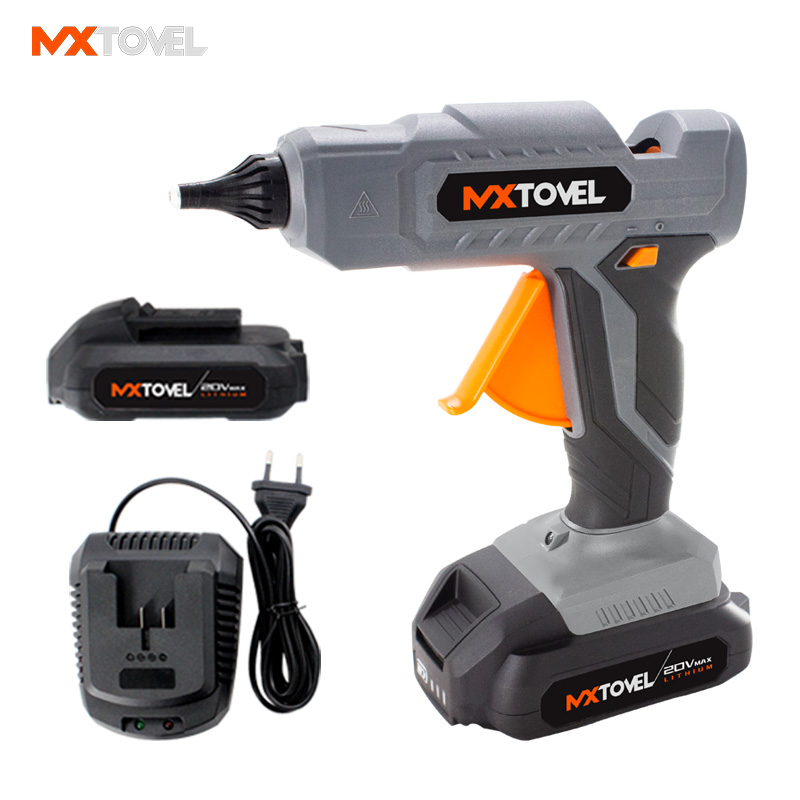
Heavy-duty packaging environments demand robust power. A dedicated 20V glue gun serves as the gold standard for high-demand applications. Corrugated box sealing requires immense adhesive output. Foam insert assembly drains thermal energy rapidly. These large 20V systems easily handle continuous duty cycles. You must emphasize compatibility with larger glue sticks. Industrial 20V units typically accept 1/2-inch or 5/8-inch sticks. This diameter ensures fewer reloads and higher extrusion volumes.
Conversely, precision assembly requires a completely different form factor. You should position integrated-battery mini systems for delicate tasks. Electronic potting requires microscopic bead control. Wire tacking demands precision without excess mess. Tight-space automotive interior assembly presents unique challenges. A bulky external 20V battery often impedes physical access inside dashboards. A sleek mini lithium glue gun slips easily into confined areas. The internal battery design creates a highly maneuverable tool.
You cannot ignore ergonomics and operator fatigue. Battery packs drastically alter the weight displacement of a hand tool. A heavy 5.0Ah battery pulling down on the handle creates a lever effect. This imbalance causes severe wrist strain during a standard 8-hour shift. Tool balance acts as a critical procurement factor. The handle angle must offset the battery weight perfectly. Operators will reject powerful tools if they cause daily physical discomfort.
Deploying battery-powered heating tools carries specific engineering risks. The battery degradation reality catches many facility managers off guard. Heating elements drain current differently than spinning motors. As the battery depletes, the voltage output naturally drops. This voltage drop directly affects the heater block performance. A tool might melt perfectly at 100% charge but struggle at 20%. You need tools with active thermal management chips. These chips pull consistent power even as battery voltage sags.
Ecosystem compatibility defines your long-term success. Procurement teams should rarely introduce an isolated battery brand. We strongly advise selecting bare tools capable of adapting to your existing battery fleets. Smart facility managers utilize specialized battery adapters. These adapters allow a new tool to accept standard DeWalt, Makita, or Milwaukee 20V/18V batteries. Standardizing your power sources prevents chaotic charging stations.
Downtime mitigation relies entirely on robust shop floor infrastructure. You must establish strict rules for battery rotation.
Audit Existing Fleets: Count every functional 18V/20V battery currently on the floor.
Establish Ratios: Maintain a minimum ratio of three active batteries per operator station (one in tool, one on charger, one cooling).
Deploy Fast Chargers: Standard slow chargers cannot outpace the drain of continuous heating elements. Install high-amp fast chargers at every cell.
Monitor Ambient Temperatures: Batteries charge slower and drain faster in extremely cold or hot warehouse environments. Adjust your ratios accordingly.
Deciding between comprehensive kits and bare tools requires careful facility assessment. Complete industrial packaging kits bundle everything together. They typically include the tool, multiple high-capacity batteries, rapid chargers, and assorted standard nozzles. We recommend these complete kits for facilities deploying cordless systems for the very first time. They guarantee compatibility out of the box. You avoid the headache of matching amp-hour ratings to thermal draw requirements.
Bare tools present a much smarter path for mature operations. We heavily recommend tool-only purchases for lines already standardized on a specific power tool brand. If your facility already owns fifty Milwaukee M18 batteries, buying new proprietary chargers wastes money. A bare tool maximizes your immediate return on investment. You simply integrate the new heating tool into your existing daily charging cycles.
Comparison: Complete Kits vs. Bare Tools | ||
Criteria | Complete Hot Melt Kits | Bare Tools (Tool Only) |
|---|---|---|
Best Suited For | First-time cordless adopters | Facilities with existing battery fleets |
Upfront Capital | Higher initial purchase price | Lower individual unit cost |
Ecosystem Impact | Introduces new chargers to the floor | Integrates seamlessly into current workflow |
Deployment Speed | Ready immediately out of the box | Requires verifying adapter compatibility first |
Testing and validation separate successful rollouts from costly mistakes. Never purchase a fleet of tools based solely on brochure specifications. You must advise your team to run a rigorous pilot test. Use your exact specific adhesive formulation during this trial. Verify the cordless unit can maintain the required "open time" (time before the glue hardens) under real shop floor thermal conditions. Test the "set time" (time required for full bond) on your actual cardboard or plastic substrates. Factory environments often feature drafts and cold zones. These real-world conditions test a tool far better than a laboratory.
Transitioning away from pneumatic and corded systems requires precise calculation. The right cordless system perfectly balances the operator's urgent need for mobility with the engineering requirement for consistent thermal output. You must look beyond simple battery capacity. Focus heavily on sustained melt rates, exact temperature controls, and daily ergonomic impacts.
Your immediate next step involves action on the floor. Encourage your procurement team to audit the current battery ecosystem today. Identify your dominant battery brand. Then, request a demo unit from your supplier. Test its sustained extrusion rates rigorously using your specific daily adhesive stock.
A: Run times vary heavily by Ah rating and ambient shop temperature. Typically, you can expect 1.5 to 3 hours of continuous heating per standard 4.0Ah battery. Using standby modes significantly extends this operational window during intermittent tasks.
A: High-end 20V models effectively bridge the gap for manual assembly and packaging tasks. However, pneumatic extrusion remains vastly superior for dispensing extremely high-viscosity structural adhesives in continuous, automated production environments.
A: Yes, they are highly reliable. This safety holds true provided the batteries are managed via industrial-grade charging stations. Ensure your chosen glue gun features built-in low-voltage protection to prevent deep-discharge cell damage.
A: The tool relies on its internal thermal mass. The heavy heater block retains functional heat for a very short window. However, you must swap batteries swiftly to prevent the adhesive from cooling and clogging the precision nozzle.


